

Society Registration
A Society is an association of individuals combined using a mutual agreement to deliberate, govern,
and act cooperatively for some common charitable or non-profit purpose. In India, societies are usually
registered under the Societies Registration Act, 1860 (or its state-specific variants). It is one of the most
popular structures for NGOs, educational institutions, cultural associations, and social welfare groups.
- Key Roles
- Eligibility Criteria
- Business Activities Allowed
- Benefits of Registration
Governing Body / Managing Committee: This consists of the President, Vice-President, Secretary,
Treasurer, and executive members. They are elected by the general body and are responsible for the
day-to-day administration, financial management, and execution of the society's objectives.
General Body (Members): Comprises all the registered members of the society who have
subscribed to the Memorandum. They hold the ultimate power to elect the Governing Body, pass
annual budgets, and amend the society's bye-laws during general meetings.
Minimum Members: A minimum of 7 persons is required to form a state-level society. For a
national-level society (All-India character), typically 8 or more persons from different states are
required.
Legal Capacity: Members can be Indian citizens, foreigners, or even other registered societies and
companies (subject to specific state regulations).
Non-Profit Motive: The society must be formed strictly for charitable, literary, scientific,
educational, or social welfare purposes, with no intention of distributing profits to its members.
A registered society cannot engage in core commercial or trading activities for the purpose of
generating private profit. Permitted activities are strictly aligned with its charitable objects, such as:
- Establishing and running schools, colleges, or libraries.
- Operating hospitals, dispensaries, or healthcare camps.
- Promoting literature, fine arts, science, or cultural heritage.
- Undertaking environmental protection and rural development initiatives.
Any income generated from ancillary activities (like selling rural handicrafts or publishing educational
materials) must be 100% reinvested into the society's primary objectives.
Legal Recognition: Provides the society with a legal status, allowing it to open bank accounts, sign
contracts, and hold property in its own name.
Government Grants: Registration is a mandatory prerequisite for receiving financial assistance,
grants, and subsidies from government bodies and ministries.
Tax Exemptions: Eligible to apply for 12A and 80G registrations under the Income Tax Act, which
exempts the society's income from tax and provides tax deductions to its donors.
Democratic Management: The structure naturally allows for a highly democratic, transparent, and
participatory form of governance through voting and general body meetings.
Documents Required for Registration
Document Category | Specific Documents Required | Purpose / Function |
Governing Body Members | PAN Card (Mandatory for Indian Nationals) | Primary financial identity proof required for statutory tax compliance records. |
Identity and Address Proof (Aadhaar Card, Passport, Voter ID, or Driving License) | To legally verify the identity, residential address, and citizenship of the founding members. | |
Passport-size photographs of all subscribers/members | Required for physical and visual identification on the official registration forms and constitutional documents. | |
Signed Consent Letters from all proposed members of the Managing Committee | Written confirmation demonstrating each member’s formal willingness to hold office and assume specific committee roles. | |
Society Constitution | Memorandum of Association (MOA) | Foundational legal document detailing the society’s official name, registered office address, and primary objects. |
Rules & Regulations (Bye-laws) | Dictates internal operational rules, membership criteria, meeting protocols, voting rights, and eventual dissolution procedures. | |
Registered Office Proof | Proof of Address (Electricity Bill, Telephone Bill, or Property Tax Receipt — not older than 2 months) | Officially validates the active, physical location of the society’s registered office for state correspondence. |
No Objection Certificate (NOC) from the property owner | Legal authorization proving the property owner permits the society to register and operate from their premises. |
The Registration Process
Society registration is administered at the state level by the Registrar of Societies or Charity Commissioner:
- Name Selection: Propose a unique name for the society. It must not violate the Emblems and Names (Prevention of Improper Use) Act, 1950, and should not imply government patronage without authorization.
- Drafting the MOA and Bye-laws: Expertly drafting the foundational documents, which must be signed by all founding members and witnessed by a Gazetted Officer, Notary Public, or Chartered Accountant.
- Filing the Application: Submitting the signed MOA, Rules & Regulations, member KYC, affidavits, and requisite fees to the jurisdictional Registrar of Societies.
- Verification and Approval: The Registrar scrutinizes the documents. Physical visits to the registered office may be conducted in some states.
- Issuance of Certificate: Upon satisfactory review, the Registrar issues the Certificate of Registration along with the certified copies of the MOA and Bye-laws.

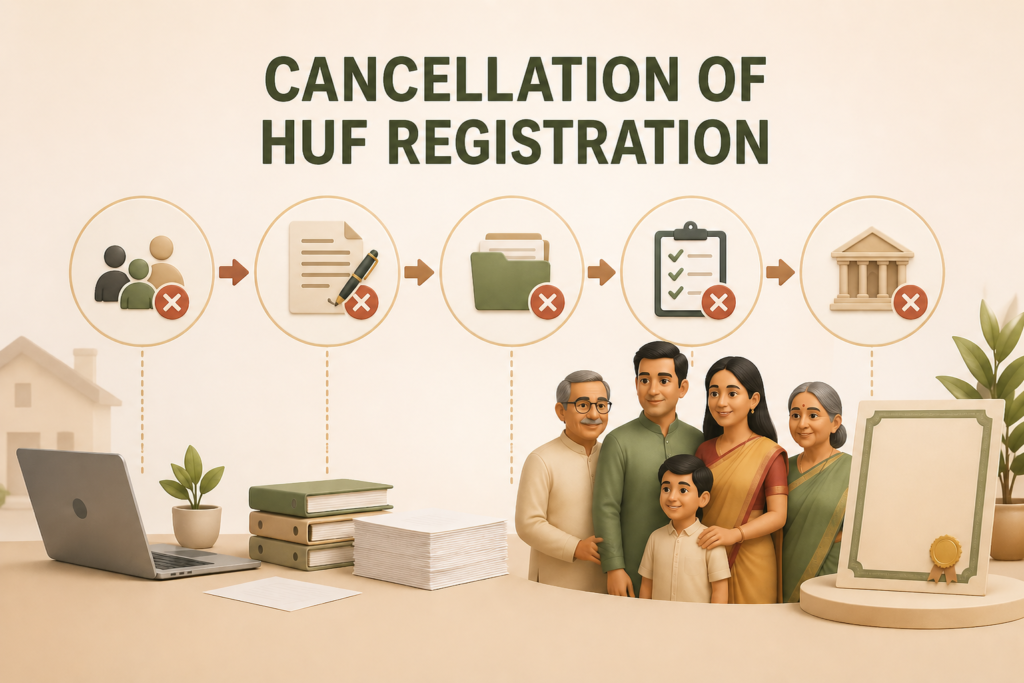
Cancellation of Registration Process (Dissolution)
A society cannot simply close its doors; dissolution must be executed methodically:
- A special resolution must be passed by at least three-fifths (3/5) of the society’s members in a special general meeting convened for this exact purpose.
- All outstanding debts and liabilities must be paid off entirely.
- No Asset Distribution: Crucially, any surplus property or funds remaining after settling debts cannot be distributed among the members. They must be transferred to another society with similar objectives, or vested with the government.
- A formal dissolution report must be submitted to the Registrar of Societies for the final strike-off.
Key Compliances
Compliance Event | Requirement | Due Date / Frequency |
Annual General Meeting (AGM) | Mandatory meeting of the general body to approve budgets, audit reports, and elect the managing committee. | Once a year (typically within 6 months of financial year end) |
Annual List of Managing Body | Filing the updated list of Governing Body members with the Registrar of Societies. | Within 14-30 days of the AGM (varies by state) |
Audited Accounts Filing | Filing the annual audited balance sheet and income/expenditure account with the Registrar. | Annually |
Income Tax Return (ITR-7) | Annual filing for entities claiming exemption under Section 11/12 of the IT Act. | 31st October of every year |
FCRA Compliance | Filing annual returns (FC-4) if the society holds a Foreign Contribution Regulation Act (FCRA) license. | 31st December of every year |
Why Choose Coremind Solution for Your Society?
✓ A True Multi-Disciplinary Edge
Non-profit compliance is vastly different from corporate compliance. Our integrated team of Cost and Management Accountants (CMAs), Chartered Accountants (CAs), Company Secretaries (CSs), and Legal Professionals (Lawyers) is uniquely equipped to handle the intersection of state society laws and central tax regulations flawlessly.
✓ Bulletproof Drafting
State Registrars frequently reject applications due to poorly drafted Bye-laws. Our legal experts meticulously draft your MOA and Rules & Regulations to ensure absolute clarity regarding membership, voting rights, and charitable objects, guaranteeing smooth registration.
✓ Comprehensive NGO Registrations
Securing the Society Registration Certificate is only step one. Our CAs and CMAs seamlessly manage subsequent vital registrations, including 12A and 80G tax exemptions, NITI Aayog Darpan registration (crucial for government funding), and CSR funding eligibility (Form CSR-1).
✓ State-Level Liaisoning
Because societies are governed by state laws, the procedures vary. Our team handles all liaisoning with the local Registrar of Societies, taking the administrative burden completely off your managing committee.
✓ Meticulous Annual Governance
We ensure your society’s democratic integrity is legally maintained by assisting with AGM documentation, filing annual lists with the Registrar, and executing precise statutory audits to protect your tax-exempt status.
Coremind Solution: Scale with Confidence. Comply with Precision. Partner with COREMIND SOLUTION
Get a Free Consultation Today
Start your journey toward financial clarity and structural integrity with CoreMind Solutions.